
The Holy Incel™: How Religious Institutions Convert Male Frustration into Moral Authority
4 min read
The Holy Incel™ illuminates how religious institutions have historically converted male sexual frustration into moral authority, spiritual virtue, and institutional loyalty. Across traditions – from Buddhism and Christianity to Hinduism and Islam – unmet desire is recast as spiritual power under institutional supervision. This is a pattern echoed today in online incel communities that enforce purity, hierarchy, and alienation. Both dynamics are sustained through ideological containment, moral laundering, reward structures, weaponised celibacy, and rigid binaries that offer only sanctification or rage. The Holy Incel™ challenges those binaries, advocating for celibacy free from doctrine and for reclaiming desire from systems and institutions that turn private longing into a source of public control.


The Holy Incel™ is a conceptual lens for understanding how religious institutions – across continents, cultures, and centuries – have absorbed male sexual frustration and repurposed it into moral authority, spiritual legitimacy, and institutional loyalty.
Seen through the wider lens of Radicalised Masculinity™, The Holy Incel™ reveals institutional celibacy as an early blueprint for how male frustration is radicalised, repackaged, and deployed as moral authority.
This isn’t a claim that all celibates are incels, or that devotion equals radicalisation. But it is an invitation to notice the shared scaffolding: the way personal lack becomes ideological identity; how unmet desire becomes doctrinal devotion; and how emotional pain becomes institutional power.
Where modern incels radicalise online, religious institutions have long enacted their own version of this – converting sexual frustration into holiness, discipline, and status.
The Core Premise
Modern incels gather in digital enclaves and transform rejection into rage, superiority, and communal identity.
Religious institutions have historically performed a version of the same manoeuvre – converting carnal desire into spiritual calling.
A man who found himself unchosen, undesired, or uncertain of his place in the world could be absorbed by a monastery, an order, a seminary, or a spiritual path that reassured him that lack is not failure – it is divine selection. Appetite is not shame – it is sanctification. Desire is not your own – it belongs to God. Especially if that desire is channelled back into the institution that redefined it.
Celibacy becomes meaningful, powerful, and “holy” only when legitimised by an institution that benefits from it.
Sanctified Incels™
In modern discourse, “incel” points to rage-filled online subcultures. In religious history, Sanctified Incels™ points to individuals whose involuntary celibacy was absorbed, blessed, and reframed as spiritual virtue.
Instead of radicalising online, their frustration was redirected into:
prayer
asceticism
martyrdom
doctrinal study
community service
and loyalty to institutional authority
In both cases, the emotional starting point is similar – what differs is the meaning assigned to it and the narrative built around it.
Cross-Religious Applications
Though the terminology and cultural nuances may differ, the pattern appears across multiple traditions, as seen in some of the examples below:
Buddhism
Monastic traditions treat the body (especially the female body) as an obstacle to enlightenment.
From Desert Fathers to celibate priests, abstinence becomes a route to divine authority – and gendered exclusion.
Hinduism
Brahmacharya elevates celibate men as spiritual elites, often encoded in gender hierarchy.
Islam
Certain sects valorise male restraint as spiritual supremacy while policing women’s bodies as sources of temptation.
The cultural syntax differs, but the structure does not. In every case, male frustration is reframed as spiritual power – but only under institutional supervision.
Modern Parallels: Digital Monasteries
Today’s incel communities function like algorithmic monasteries:
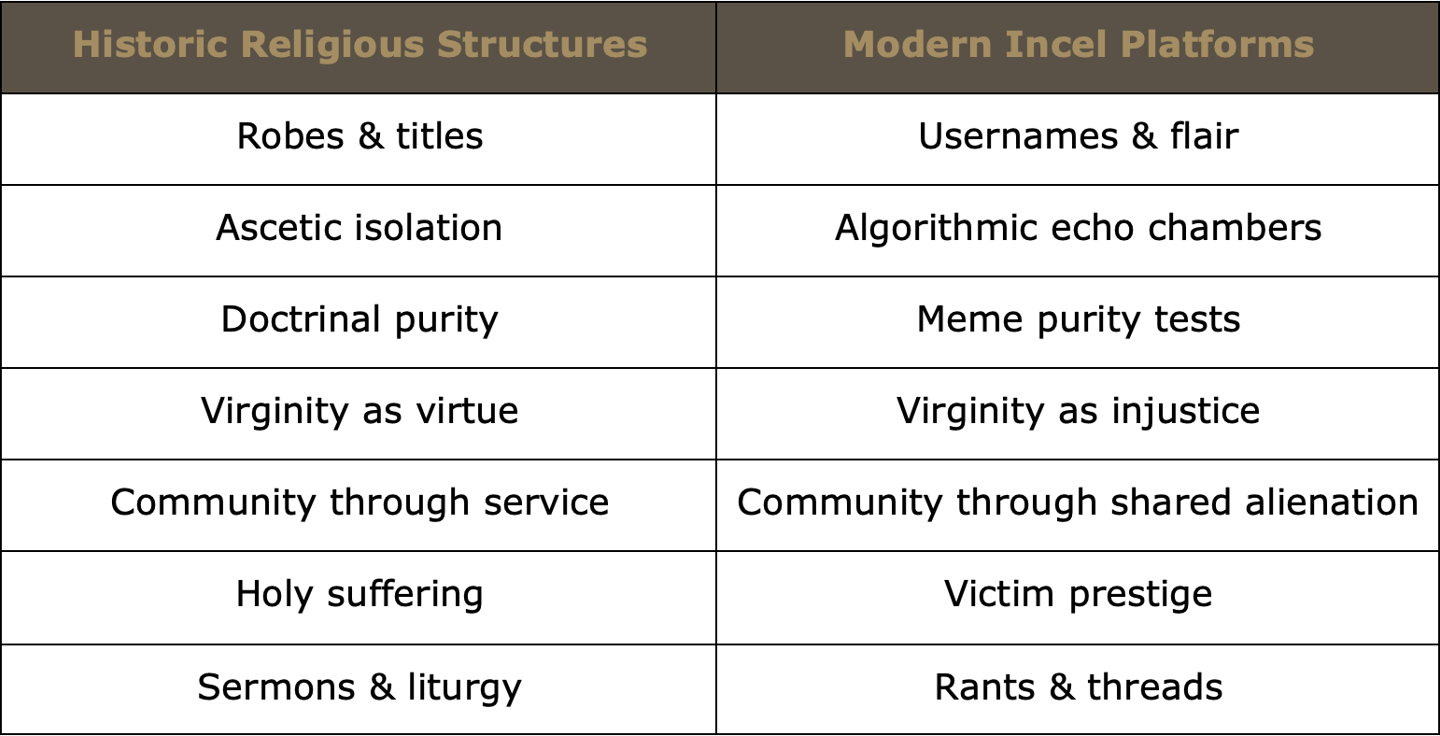
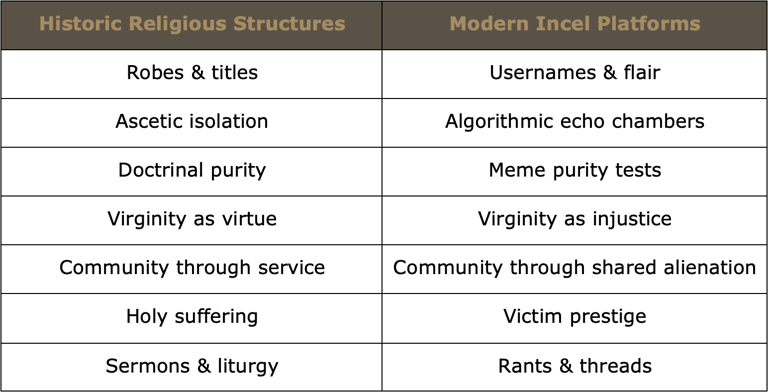
The architecture is the same. Only the aesthetics have changed.
The Structural Logic of The Holy Incel™
1. Ideological Containment
Institutions offer narratives that transform unmet desire into “sacrifice”, “purification”, or “calling”. Celibacy becomes a pressure valve – a place to deposit desire, longing, confusion, and frustration. This keeps devotion high and dissent low.
2. Moral Laundering
Modern incels say: “women are shallow; rejection proves we see the truth.”
Religious institutions have said for centuries: “your rejection of the world makes you holy; your suffering makes you closer to God.”
Both systems turn lack into moral elevation. Where the religion offered robes, rituals, and reverence, incel forums offer purity, memes, and martyrdom-by-algorithm. Sexual suffering is moralised, rewarded, and made into an identity.
3. Reward Infrastructure
Every system needs incentives. For religious celibates, those incentives included:
clothing
titles
respect
leadership roles
spiritual authority
For modern incels it’s:
usernames
flair
ideological “rankings”
meme prestige
communal validation
One system built with liturgy; the other built on nihilism. But both offer status – if you adhere to the rules.
4. Weaponised Celibacy
Both religious and incel cultures have produced men whose asceticism can calcify into resentment. Religious archives are filled with celibate figures whose writings radiate hostility toward women. Modern incel culture echoes this – without the dogma being deemed divine.
5. False Binaries
Religious institutions and incel ecosystems create the same trap of either being seething or sanctified. You’re either radicalised online or radical for God.
The Holy Incel™ disrupts that binary and makes space for something more human and humane.
Beyond the Binary
Not everyone who is involuntarily celibate wants to become a monk or an incel, a martyr or a misogynist. Many simply want:
celibacy without script
singleness without shame
abstinence without ideology
The Holy Incel™ invites us to imagine celibacy as a season, not a referendum; a circumstance, not a sacrament. It is a call to reclaim agency from systems – religious or digital – that try to interpret unmet desires on behalf of the individual.
Why This Matters
The Holy Incel™ enables us to finally name what institutions have always known: frustrated men are highly malleable – if you give them a narrative. Religious structures did not eliminate male desire. They rebranded it and made it serviceable. Modern incel culture attempts to do the same.
Understanding this parallel allows us to:
demystify celibacy
decouple morality from abstinence
expose systems that turn private pain into public power
reclaim desire from institutions that use it as a form of control


What do you think...?
© It’s Nadine™ | The Holy Incel™
For educational, analytical, and commentary purposes only. If referencing or teaching, please cite and attribute authorship.