
The Politics of Visible Damage - Who gets Read as Strong vs Broken vs Dangerous
3 min read
Visible damage is not interpreted equally: the same scar or injury can be read as resilience, fragility, or danger depending on who carries it and the biases attached to their identity. The body does not just hold wounds but context, and that context is judged instantly – often shaping how others perceive someone’s character, safety, and trustworthiness. These silent classifications influence how people are treated, with some granted assumptions of strength while others must prove stability and control. As a result, scars do not inherently signify strength; they simply mark that something happened, while “strength” itself is a social judgement shaped by perception, not reality, determining whether someone is drawn closer, kept at a distance, or placed into a category they never chose.
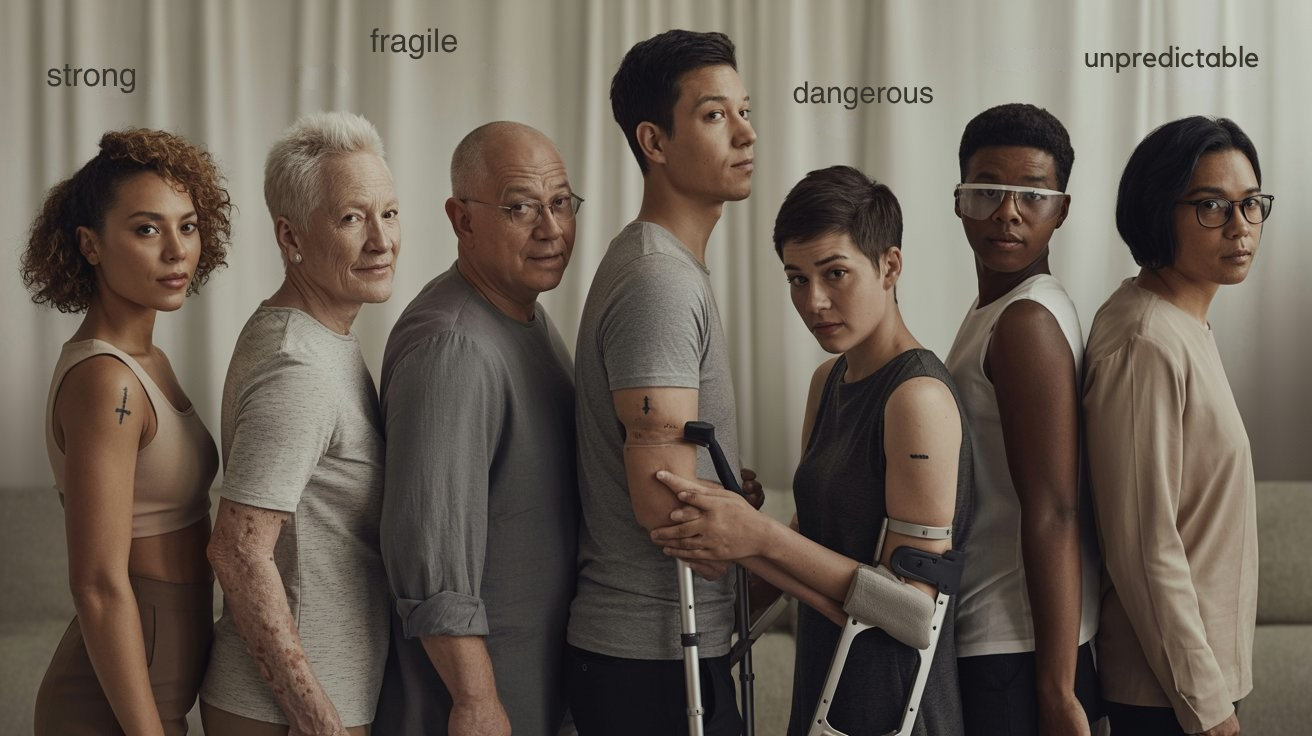
Not all damage is read the same.
Not all scars.
Not all limps.
Not all visible signs that something has… happened.
Because the body doesn’t just carry marks.
It carries context.
And that context gets read faster than anything you could ever say.
Two people can have the same scar.
Same shape.
Same size.
Same story, even.
And still be seen completely differently.
On one person, it becomes:
“Wow. You’ve been through something.”
On another:
“What’s going on with you?”
On another:
“…should I be wary?”
Same mark.
Different meaning.
And the difference isn’t the scar.
It’s the person carrying it.
Because visible damage doesn’t exist in isolation.
It gets filtered through everything people already believe.
About strength.
About fragility.
About control.
About danger.
And most of those beliefs are not neutral.
There are people whose scars get read as proof of resilience.
And others whose scars get read as evidence of instability.
Some bodies are allowed to be: Marked and still whole.
Others become: Marked and therefore suspect.
Either way, you’re: Marked and already judged.
No one says this out loud.
But you can feel it.
In the way people look.
In the way they pause.
In the way they decide – very quickly – what category you belong in.
And once that decision is made…
It’s hard to undo.
Because people don’t just see damage.
They interpret what that damage means about you.
If they already see you as “safe” –
Your scars become:
Depth.
Story.
Character.
If they don’t –
Your scars become:
Risk.
Unpredictability.
Something to keep an eye on.
And that classification is subtle.
But it affects everything.
Because now the scar isn’t just something that happened to you.
It becomes something that defines how others move around you.
And here’s where it gets uncomfortable.
You don’t get equal access to being seen as “strong”.
Some people have to work much harder to be read that way.
To prove that what they’ve been through has made them:
stable
controlled
trustworthy
While others are given that assumption automatically.
So when people say “scars are a sign of strength”
…that’s not entirely true.
Scars are a sign of something that happened.
Strength…
Is something people decide you have.
And that decision is influenced by everything else about you.
Your body.
Your identity.
Your tone.
Your history (real or imagined).
So the same visible damage can move you:
closer to people
further away from them
or into a category you didn’t choose
All without your input or consent.
And maybe that’s the part we don’t really talk about.
Not just that the body tells a story.
But that the story gets judged differently depending on who’s telling it –
even when you didn’t choose to tell it at all.